exploring the physical and geometric principles that influence shape changes in biology
Plant Biochemistry
The plasma membrane H+ ATPase plays a central role in pollen grain germination and pollen tube growth. It is a member of the P-ATPase family transporting H+ from the cytosol to the extracellular space and thus energizing the plasma membrane for the uptake of ions and nutrients. External as well as cytosolic signals from signal transduction and metabolic pathways are integrated by the PM H+ ATPase and directly translated to maintain the pollen tube growth to deliver the sperm cells to the egg apparatus for sexual reproduction, and thus for production of seeds and fruits that are the basis for human nutrition. A high number of cellular processes are involved in polar growth of the pollen tube and the tube growth can be viewed as a temporally and spatially fine-tuned network of interacting cellular processes and pathways like the cytoskeleton dynamics, vesicle trafficking and fusion, Ca2+, pH and phosphoinositide signalling, G-protein signalling and many more (Lang et al. 2014). We explore the physiological role of the PM H+ ATPase in the pollen`s life and how this key enzyme is regulated by protein-protein interactions (e.g. 14-3-3 proteins), phosphorylation/dephosphorylation by protein kinases and phosphatases, and external or cytosolic signals, e.g. by exposure to hypo- or hyperosmotic shock.

Pollen systems biology
During fertilisation of higher plants, the growth of pollen tubes relies on well-balanced transport of water between the surrounding style tissue and the pollen to deliver the sperm cells to the ovaries. By exposing pollen grains and tubes of Lilium longiflorum Thunb. to small deflections of the external osmotic potential to mimic mild drought-related water potential changes, we examine responses of involved metabolic pathways as well as cellular and signalling processes by the use of an untargeted multi-omics approach to simultaneously detect putative changes in the pollen metabolome, proteome and phosphoproteome. A deep and detailed knowledge of the regulation of the water balance in pollen is a prerequisite to understand the sensitivity of the reproduction process to drought stress to warrant food production in a changing global climate.

Green bioprinting
The sessile lifestyle caused plants to develop a high capability to dynamically change their physiological state and biochemical activity, an ability that very much contributed to their survival over the last millions of years on this planet. Therefore, plant life strategies provide a rich source of biological solutions for up-to-date problems including global climate change and limited resources. This project takes advantage of the ability of some plants to accumulate metals from the soil to extract noble and rare elements from electronic waste, which are usually recycled by environment-polluting procedures. The novelty of this project is the use of “synthetic plants”. A synthetic plant is created by printing cultured plant cells in a hydrogel scaffold that can be integrated in an engineered device.
Electronic and electrical equipment and in particular, mobile, hand-held electronic devices like smartphones, laptops or tablets have found their way into almost every household in the world and have become a fixture in our daily life. However, due to technical progress and lifestyle trends, these mobile devices have a short lifetime and make up a major part of the global e-waste (WEEE, waste electrical and electronic equipment, Abdelbasir et al 2018). Their disposal causes serious problems ranging from environmental pollution that threatens human health to social conflicts caused by the currently used ways of e-waste disposal (e.g. export into developing countries or ending up as landfill) and pyrometallurgical or hydrometallurgical techniques of recycling (Chauhan & Upadhay 2015). Many techniques used to recover precious components like noble metals and rare earth elements from the printed circuit boards (PCBs) use and release hazardous substances. Therefore, “green” eco-friendly recycling processes are urgently needed to prevent toxicity of these contaminants to humans and environment. This project addresses a new strategy to evaluate cyanogenic plant cell cultures that are growing and enclosed in portable hydrogel scaffolds for a modular, flexible and scalable phytomining system to allow an environment-friendly exploitation of electronic waste.

Sustainable bio-materials
Since the first reports of the Club of Rome in the 1970’s (Meadows et al., 1972) human society became more and more aware that economy cannot grow indefinitely and that all planetary resources are limited. The consumption of the resources by increasing human economic activities are exceeding the so called “planetary boundaries” and beyond these thresholds irreversible environmental degradation becomes definite (Steffen et al., 2015). In future, a sustainable handling of planetary resources will become more economically attractive due to rapidly increasing costs of mining. Although only 6% of the worldwide oil production is used for fabrication of polymers including plastic materials, their production and disposal raised many environmental concerns in the last years (Jambeck et al., 2015). In this scenario, renewable, natural materials for manufacturing of polymers are going to play an important role to replace synthetic materials produced from fossil resources.
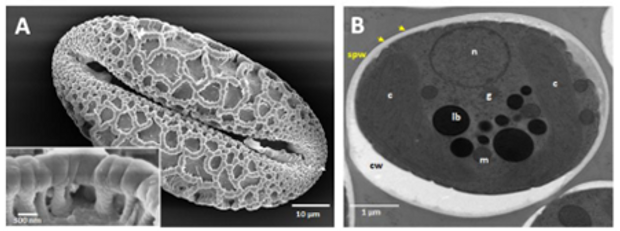
So far, many plant-derived polymers (cellulose, lignin, cutin, and latex) have been tested for commercial applications. A ubiquitous less abundant polymer with especially unique properties is sporopollenin. This tough material covers and protects the genetic material of plants from harsh environmental conditions such as UV radiation, chemicals, oxidation, mechanical stress as well as biotic attacks by bacteria, fungi or other pathogens. Sporopollenin can be found in all plant organs that deliver genes for reproduction from one individual to another, e.g. pollen and spores, but also in algae that are exposed to high mechanical stress. Due to its biological function and unique properties, sporopollenin is extremely resistant to chemical processing during fabrication, but offers new and interesting perspective of using renewable bio-materials for products that are exposed to extreme environmental conditions, ranging from roof tiles to anti-fouling coating of ships.